



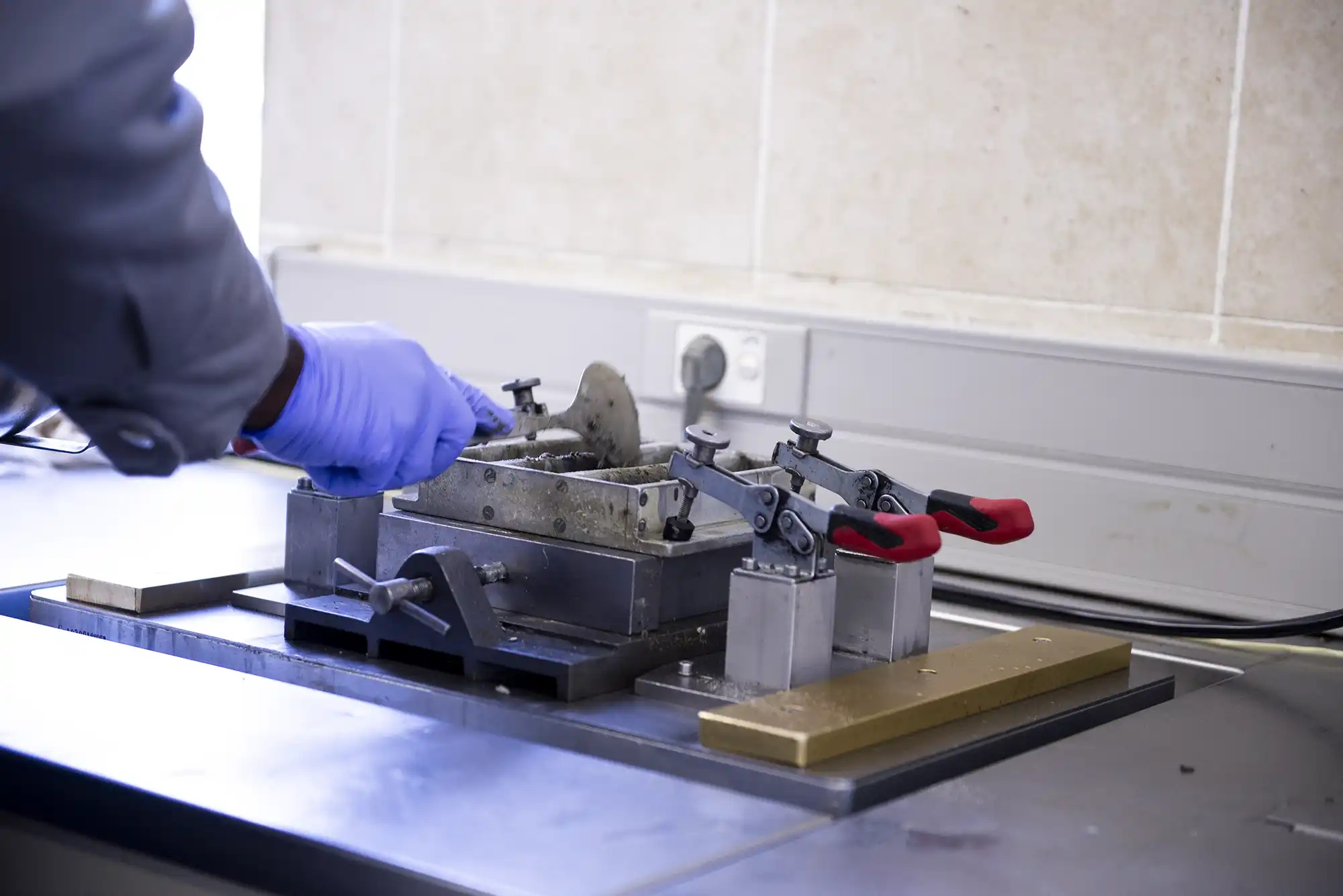
Ohorongo Cement produces five (5) different cement products. All these products are certified by the certification organizations: The Namibia Standards Institution (NSI), the South African Bureau of Standards (SABS) and the Botswana Bureau of Standards (BOBS) in accordance with the most recent versions of the relevant standards. To ensure compliance and guarantee that customers are supplied with consistent high-quality cement, all the cement products undergo various laboratory tests. The main tests conducted at Ohorongo Cement are discussed below.
COMPRESSIVE STRENGTH
The cement compressive strength is the ability of the cement to resist compressive forces applied to it without breaking. The unit of compressive strength is MPa (megapascal), which is a unit of pressure describing the amount of force applied to a certain area. The tested compressive strength is therefore the maximum amount of pressure that the cement can withstand before it breaks.
The compressive strength test is performed in accordance with the standard EN 196-1/ SANS 50196-1. It is conducted by making 40 x 40 x 160 mm test specimens called prisms from cement, standardized sand and water. The cement prisms are tested for strength at 2, 7 and 28 days after the prisms are made. The strength test is done by placing an increasing amount of force on a prism until it breaks. The force at which it breaks is recorded and the pressure is calculated using the formula pressure = force/area. This pressure (or compressive strength) indicates the amount of pressure that the cement prism can resist. The standard specifies the minimum pressure that each cement type must resist, and all Ohorongo Cement products exceed this required strength.
SETTING TIME
Cement setting time is the time that cement paste takes to harden after the cement is mixed with water. The setting time test is performed in accordance with the standard EN 196-3/ SANS 50196-3. Two setting times are tested on cement – initial setting time and final setting time. The initial setting is the time elapsed between the moment water is added to the cement to the time at which paste starts to harden. The final setting time of cement is the time elapsed between the moment the water is added to the cement to the time at which paste has completely hardened and has attained sufficient firmness to resist certain definite pressure. Each cement product has a standard minimum setting time that it must exceed.
SOUNDNSS (EXPANSION)
Soundness describes the ability of cement to retain its volume after it hardens. Soundness of cement is used to detect the presence of uncombined lime in cement, which causes cement to expand after it has hardened. The soundness test is performed in accordance with the standard EN 196-3/ SANS 50196-3. A sample of hardened cement paste is boiled for a fixed time so that any tendency of expansion is sped up and can be detected using the Le-Chatelier apparatus. The dimensions of the test specimen are measured before the specimen is boiled, and then again after it has been boiled and the difference is calculated to determine how much the specimen has expanded due to the heat. The standard specifies the maximum allowable expansion for each cement.
LOSS ON INGNITION
The loss on ignition (LOI) test is performed to determine the amount of volatile substances (gases) that are driven off when cement is heated to very high temperatures. LOI is determined by calculating the weight loss of a sample after it has been ignited at a high temperature until it reaches a stable mass. Weight loss can be due to the evaporation of moisture and the volatilization of various components. For cement, organic material is burned off at about 500°C and most of the carbonates are removed at 950°C as carbon dioxide. A high LOI can indicate pre-hydration (presence of excessive moisture in the cement) or carbonation of the cement, which can have a negative impact on the cement strength and overall quality. The LOI test is performed in accordance with the standard EN 196-2/ SANS 50196-2.
SULFATE CONTENT (SO3)
The rate of hardening of cement is controlled by the addition of Calcium Sulphate (Gypsum). Determination of the SO3 content is an indication of the amount of Calcium Sulphate added to the cement. The Calcium Sulphate reacts with the C3A phase of the clinker to delay the hardening or setting of the cement. SO3 of blended cements such as the CEM II B-V 42.5N cement is lower than that of pure Portland cement due to the addition of constituents such as Fly Ash that acts as a type of dilution. SO3 can be determined by means of Wet Chemistry or as part of the chemical analysis by means of XRF. The SO3 test is performed in accordance with the standard EN 196-2/ SANS 50196-2.
INSOLUBLE RESIDUE (IR)
The insoluble residue test of cement determines the percentage of non-cementing materials in a cement sample, which are primarily impurities that do not contribute to the binding properties of the cement. The main source of insoluble residue is silica that did not react during the burning process in the kiln as well as silica introduced with the additional constituents such as Limestone and Gypsum. Insoluble residue does not take part in the hydration process of mortar, thereby reducing the overall strength gain of cement. Higher amounts of insoluble residue can negatively affect compressive strength, specifically at early ages. The IR test is performed in accordance with the standard EN 196-2/ SANS 50196-2.
CHLORIDE CONTENT (Cl)
Chlorides are included in the cement when the chlorides in the raw material and fuels are incorporated into the clinker during cement production. Chlorides in cement will attack the reinforcement in concrete structures in the form of corrosion. It is important to monitor and limit the amount of chlorides in cement to ensure the integrity of a concrete structure. The chloride content test is performed in accordance with the standard EN 196-2/ SANS 50196-2.